I’ll be honest – I didn’t know much about Harrison’s Cave before visiting Barbados. Most Caribbean islands have volcanic origins, and I figured Barbados was the same. Turns out I was completely wrong, and that difference is exactly why this cave exists.
How Barbados (and This Cave) Actually Formed
So here’s what I learned from the guide, though I’m paraphrasing because the geological explanation went over my head a bit: Barbados isn’t volcanic like most Caribbean islands. Instead, it formed when tectonic plates collided and pushed up some underwater formation – an “accretionary prism,” they called it. Coral reefs grew on top of that over millions of years, creating thick limestone layers across the island.
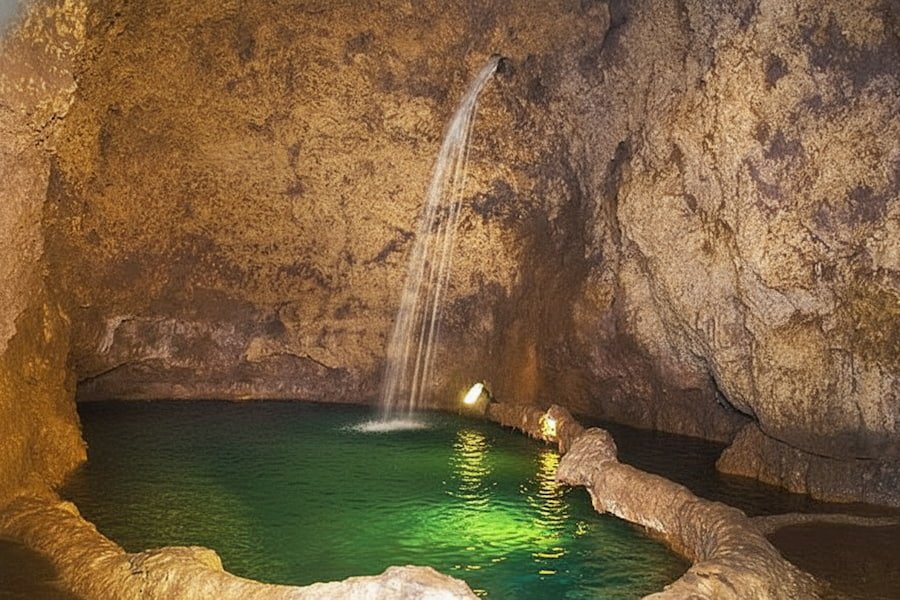
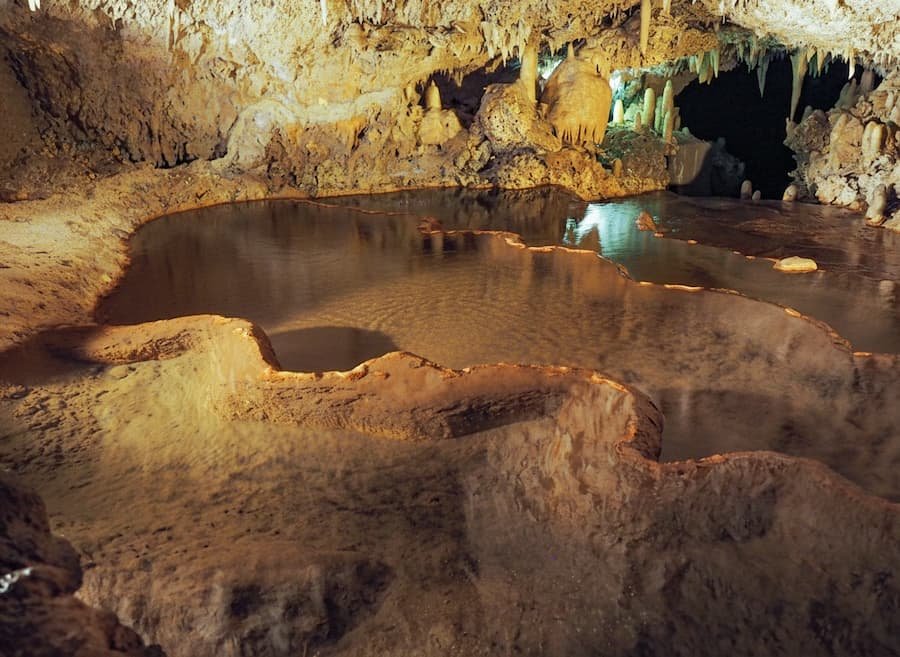
The cave itself formed from water erosion. Rainwater mixed with carbon dioxide creates a weak acid that dissolves limestone. This process took thousands of years, with calcium-rich water slowly carving out the passages and creating those formations you see – stalactites hanging from the ceiling, stalagmites growing up from the floor. In some spots, they’ve actually joined together to form columns.
The guide mentioned the stalagmites are still growing, less than the thickness of paper each year. They said that’s actually considered fast in geological terms, which gives you some perspective on how slowly these things develop.
The Numbers (For Those Who Care About Specifics)
The cave system extends about 2.3 kilometers, though visitors only see a portion of that on the tram tour. It sits 700 feet above sea level. The largest cavern – they call it “The Great Hall” – reaches about 50 feet high. Inside, the temperature stays at a consistent 76°F year-round, which was actually a relief after the heat outside.
The History Part (More Interesting Than I Expected)
The cave was first officially documented in 1795, named after Thomas Harrison, who owned the surrounding land in the early 1700s. He founded a school in 1733 that eventually became Harrison College, but apparently nobody knows if he ever actually went into the cave himself. I found that detail strangely amusing.
People tried exploring it throughout the 1800s, but the natural entrances were too difficult to navigate. Then it was basically forgotten for almost 180 years until the 1970s.
A guy named Jack Peeples rediscovered it in the early 70s. In 1974, the Barbados National Trust brought in a Danish cave expert – Ole Sorensen – to properly map the whole system. He worked with two local guys, Tony Mason and Allison Thornhill, to document everything.
The Barbados government saw tourism potential and started development work after that. They had to excavate tunnels large enough for trams, which sounds like a massive undertaking. The equipment operator who first broke through the bedrock was Noel Boyce, and they named the main entrance tunnel after him. Small recognition for what must have been nerve-wracking work.
The cave opened to tourists in November 1981. They did major renovations in 2006-2007, and apparently they’ve kept updating things since then.
What Struck Me About All This
The thing that stuck with me wasn’t just the cave itself – it was realizing how different Barbados is geologically from everywhere else in the Caribbean. The guides make a point of explaining this, probably because most visitors, like me, assume all these islands formed the same way.
Also, the fact that it took until the 1970s for anyone to properly explore and map this place feels wild. It’s not like Barbados is some remote location. Sometimes the best discoveries are hiding in plain sight, I guess.
The tram tour itself is smooth and well-organized – they clearly put serious money into making this accessible. Whether that’s good or bad depends on what kind of experience you want. We appreciated not having to scramble through tight passages, but I imagine some purists would prefer a more rugged exploration. That option doesn’t exist here though, at least not for regular tourists.
If you’re in Barbados and have a couple hours, it’s worth seeing. Just manage expectations—it’s a guided tram tour, not an adventure expedition. The formations are impressive, the history is surprisingly interesting, and the whole thing gave me a better understanding of why this island is unique.